
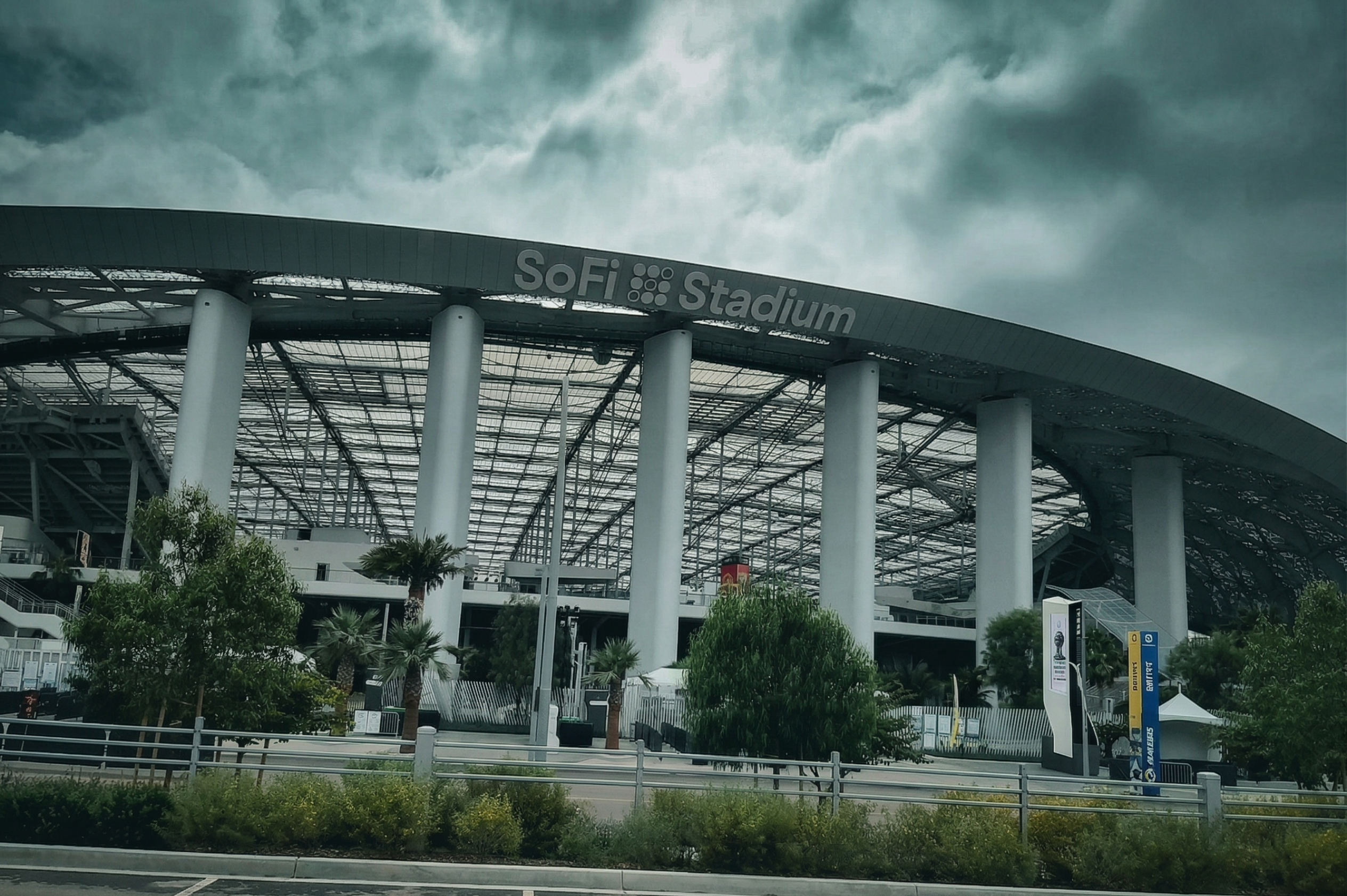
The first thing SoFi Stadium asks you to do is look up. The second is to go down.
Above you, a sweeping canopy spans an enormous entertainment complex. Below street level, the seating bowl plunges into the ground. Suspended over the field, an oval screen makes the familiar stadium scoreboard look modest.
The building is designed to provoke a reaction. And it does.
But once the initial “how did they build that?” wears off, another question becomes more interesting: how do you judge a project like this?
By its architecture? Its price? The crowds it attracts? The water it saves? Or the experience of the person trying to get home after the final whistle?
SoFi’s story lives in the gap between those answers. It combines remarkable design and engineering with an expensive, disrupted delivery and ongoing questions about access, value, and long-term impact. Calling it a triumph tells only part of the story. Calling it a failure misses the building standing in front of you.
First, understand the size of the bet
SoFi Stadium, home to the Los Angeles Rams and Chargers, anchors the 298-acre Hollywood Park development in Inglewood. HKS’s design unites the stadium, the 6,000-seat YouTube Theatre, and American Airlines Plaza under a shared canopy, with parks, pathways, and a lake extending the experience outdoors. The broader setting is important because an ordinary stadium relies heavily on activities inside its bowl, but a district can also attract visitors before, after, and on non-event days. The goal is clear: make the stadium a focal point that draws people back repeatedly. However, achieving this involves coordinating architecture, transportation, landscaping, retail, event management, and neighbourhood relations. Led by Stan Kroenke’s privately funded vision, the project team, including HKS, landscape architect Studio-MLA, the Turner-AECOM Hunt joint venture, and specialised engineers, worked to transform that vision into a buildable plan. The AIA’s project credits also mention Legends Global Planning as project manager. While a strong client enables ambitious decisions, the district’s success still depends on regulators, utilities, transportation agencies, contractors, and the local community. Private ownership does not eliminate these interfaces.
The airport said “lower”. The designers went deeper.
SoFi’s close proximity to Los Angeles International Airport influenced its key architectural decision. Height limits led to much of the bowl being situated approximately 100 feet below ground level. HKS and Studio-MLA incorporated landscaped terraces and canyon-like approaches to make the descent feel naturally connected to the outdoors. The real ingenuity lies in the experience. Excavating a deep bowl is primarily an engineering challenge, but designing it so that thousands of visitors feel immersed rather than entering a giant basement is a notable design feat.
This offers a valuable lesson for smaller projects: a challenging site condition can become a defining feature if you address it early. The awkward boundary, planning restriction, or level change might hold the key to a distinctive idea.
However, going underground was not free of challenges. It involved excavation, retaining structures, drainage, and complex level transitions. Achieving seismic resilience required careful engineering; Walter P. Moore details separate structural systems for the bowl, retaining wall, and roof, including roof isolation technology. Being underground did not inherently make the stadium earthquake-proof.
The success lay in crafting a comprehensive response to multiple demanding conditions. The trade-off was added complexity, which needed careful design, coordination, and financing.
A roof that does more than keep the rain off
SoFi’s canopy defines the building’s recognisable outline. Its translucent ETFE surface and open sides strengthen the sense of indoor-outdoor connection. Daylight and passive ventilation were part of the original design, complementing the landscape and local microclimates. The roof is both an environmental feature and a compelling public presence: it shapes light, shade, and atmosphere, and affects how the venue engages with its surroundings. This approach deserves recognition because architectural decisions influence comfort and resource efficiency for decades. They should be carefully weighed before choosing specific sustainability features. However, passive design requires operational judgment, since crowd density, temperature, sunlight, and wind all vary. Maintaining consistent comfort across seats, times, and events requires ongoing assessment. A roof alone cannot ensure uniform conditions beneath it. The key lesson is to design for the local climate and monitor the venue’s actual performance. The image captures a moment; the operator manages every season.
The bill is enormous.
SoFi is commonly estimated at approximately $5 billion, but this figure requires context: reported totals vary, and whether it includes surrounding infrastructure matters. This distinction is crucial when considering the increase from early estimates of about $2.6 billion. These numbers indicate significant escalation, but they don't alone provide a precise, comparable measure of overspending on a consistent scope. To determine an exact percentage overrun, we need clarity on what each estimate included, such as the stadium, nearby facilities, enabling works, infrastructure, financing, or subsequent additions, and an agreement on the baseline and record of approved changes. Criticism should be more precise here. An unpublished change register doesn't prove the project team lacked a change-control process; it merely prevents outsiders from reconstructing the full cost story from headline figures alone. For those commissioning a venue, this ambiguity offers a practical lesson: major changes should specify the benefits sought, their impact on cost and schedule, operational implications, and approval authority. “The owner wanted it” explains motivations but not whether the decision offered good value. Also, private finance considerations should be carefully worded. The stadium’s funding approach and the public resources supporting the surrounding district are different matters. Streets, transit, and event services are part of the bigger picture, and private construction costs alone don't answer questions about public benefit or expense. A striking building can justify ambition, but it cannot replace a clear explanation of value.
Then the weather changed the calendar
Construction aimed for a 2019 NFL season opening, but the wet winter of 2016-17 delayed it to 2020. The Super Bowl allocation changed from 2021 to 2022 in May 2017, before the pandemic. This timing matters, as COVID-19 caused further disruption and led to SoFi’s first NFL season without spectators. Combining these events can obscure their individual impacts. The key scheduling lesson is often underestimated: losing time can mean missing a broader business window. A stadium opening involves fixtures, hospitality, broadcasts, and opportunities that may not simply move to a later date. Weather planning must consider more than just rainy days. It should identify which activities are vulnerable, what happens if excavation floods, and which deadlines become impossible if activities slip. We can't determine SoFi’s internal risk register from the outcomes, but it’s clear that contingency planning must align with construction phases and deadlines. Adding a percentage to a spreadsheet is less helpful than understanding how the project reacts when a critical activity halts.
The screen is the show.
Samsung’s Infinity Screen offers one of SoFi’s most striking features: an oval, double-sided display covering about 70,000 square feet, suspended 122 feet above the field. However, the less visible technology matters just as much. Deloitte highlights work on the venue’s digital guest experience, data capabilities, and cybersecurity, which link interactions before, during, and after a visit. To fans, these systems involve small moments: finding the right entrance, getting a ticket, or navigating an unfamiliar space. For operators, they create a connected service that requires clear ownership and reliable support. The key lesson is to involve technology and operations teams early, ensuring the physical design supports their needs. Networks require space, power, and routes; equipment needs maintenance access; digital services need recovery plans. The project brief should cover these aspects. Connectivity also brings responsibility: understanding system dependencies, access rights, and how to maintain operations if a service fails. A simple design-review question: if an app, network, or ticketing system fails, how do we keep assisting visitors? Smaller venues might not need SoFi’s theatrical hardware but must still answer this question.
A great entrance is measured in people, not equipment
In 2021, long lines before a BTS concert highlighted how tough it can be to find the right balance. Reports detailed entry issues like screening and vaccination checks. Importantly, the venue was already exploring alternatives; this incident shouldn’t be viewed as the sole reason for change. In November 2022, the stadium announced its partnership with Evolv for screening. This move reflects a broader operational challenge: every entrance process must balance security, efficiency, and the experience of those waiting. It's tempting to see this as a simple technology success: faster equipment, shorter queues, problem solved. But real-world entrances are more complex. Ticketing issues, bag checks, secondary screening, unclear signage, and varying arrival times all interact. Speeding up one step might just shift the queue further down the line. A scanner’s throughput doesn’t capture overall entrance performance. Future projects should rehearse the entire visitor journey, testing late arrivals, accessibility needs, failed ticket readers, and growing queues. Clarify who intervenes, where people wait, and how instructions are communicated. Technology can support this system, but claims of faster entry need evaluation separately from detection effectiveness. Both are important, but neither is guaranteed by “AI”. Operational improvements are valuable and remind us that reaching practical completion is a milestone, one step in ongoing venue development, not the end of learning.
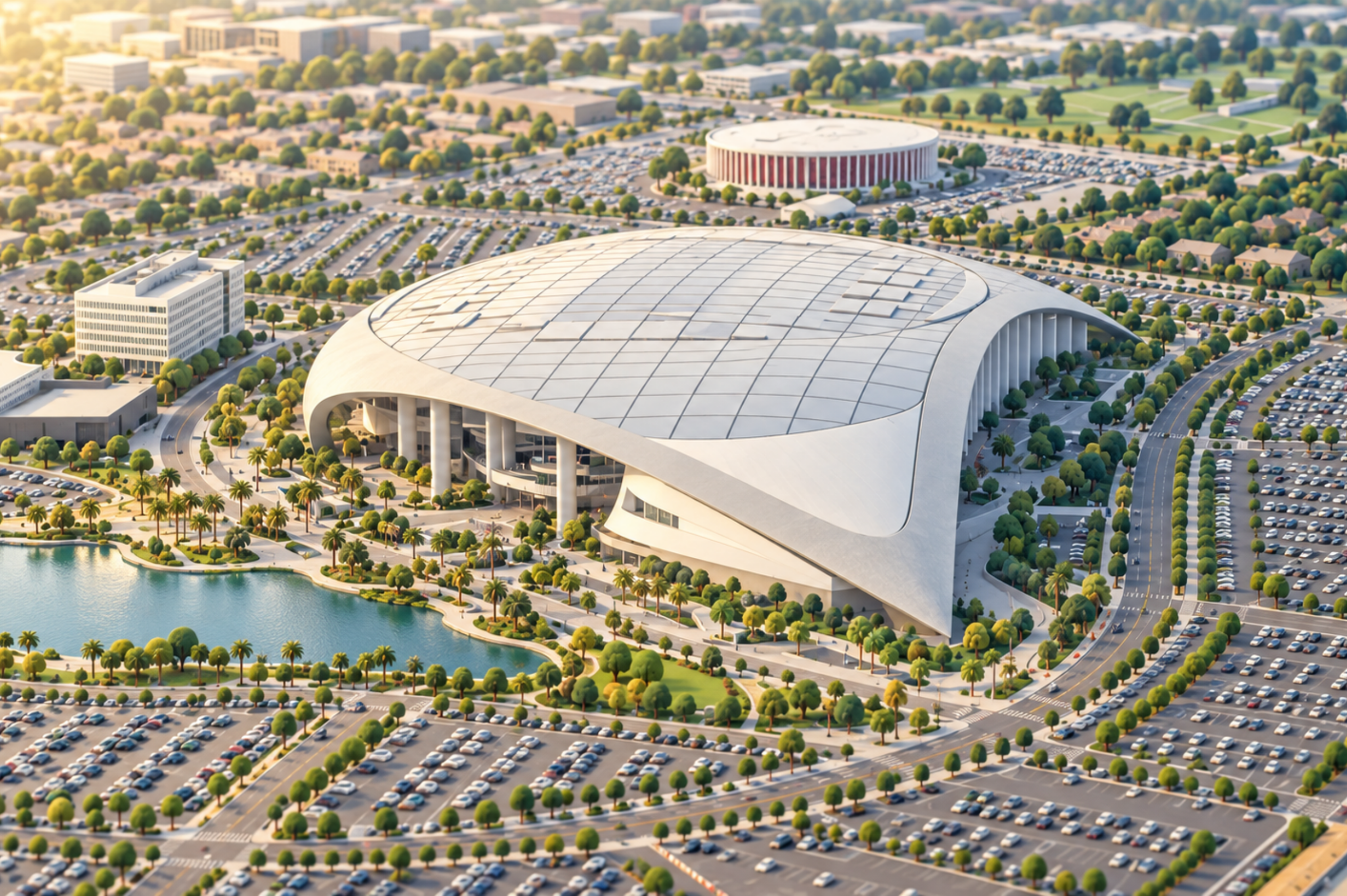
The lake
Lake Park provides a visual counterpoint to SoFi’s striking architecture while serving practical purposes. Its landscape design captures and filters stormwater, and the campus also uses recycled water supplied through its partnership with West Basin. According to SoFi’s landscape reports, the campus uses about 26 million gallons of recycled water each year, reducing demand on drinking water supplies. This figure does not represent water recycled by the lake itself; rather, it reflects the combined efforts of the supply partnership and the on-site stormwater system, which are related but separate. This approach exemplifies multi-functional design: investments meet several needs, such as managing water, creating gathering spaces, and improving movement through a large development, particularly when these functions are thoughtfully integrated. In 2022, SoFi earned ISO 20121 certification for event sustainability management and plans to maintain compliance through 2025, working with sustainability consultant Honeycomb Strategies to track impacts and improve practices. An ongoing commitment to responsibility, including setting objectives, monitoring progress, and making adjustments after opening, is essential. However, certification alone does not prove that the entire development is free of significant environmental impacts. A thorough assessment considers materials, operational energy, waste, and visitor transportation. SoFi’s water strategy is commendable, but it does not mean all sustainability issues have been fully addressed.
The stadium experience
A beautifully designed concourse alone cannot solve access challenges. Transportation impacts punctuality, accessibility, neighbourhood disruption, and an event's environmental effects.
The Inglewood Transit Connector’s current plan differs from the original automated people mover proposal. Rephased in 2025, the project now emphasises mobility hubs, pedestrian upgrades, and event-day bus connections, while still keeping future options for a people mover open. The first phase aims to deliver benefits before LA28.
The conclusion should not be that the transportation issue has disappeared or that no action is needed. Service quality depends on capacity, frequency, walking routes, accessibility, and the ability to handle post-event movements.
This highlights a common boundary challenge. The stadium, transit network, and nearby streets may have separate owners and budgets, yet visitors experience them as a single journey.
Local residents’ experience extends even further. Parks and investments bring benefits, but event traffic and area changes demand attention. Fair evaluation requires evidence of who gains access to opportunities and who bears disruptions; attendance figures alone don’t suffice.
For future venue projects, the practical takeaway is to clarify responsibilities beyond the site early on and define success from both visitors’ and neighbours’ perspectives.
A busy calendar is a win.
SoFi has proven its capacity as a key venue for major events. Its role in the 2026 World Cup added another achievement before hosting the 2027 Super Bowl. LA28 plans to use the stadium for swimming competitions, the Olympic Opening Ceremony, and the Paralympic Opening Ceremony. These activities highlight the stadium's versatility, helping it stay relevant by serving different audiences. However, each event type requires modifications, staffing, rehearsals, and operational planning. A full economic assessment requires more than just impressive bookings; it includes regional visitor spending, operator revenue, owner returns, and long-term community benefits. Money spent in nearby hotels doesn't automatically help cover stadium construction costs. Without detailed financial disclosures, claiming the investment has fully paid for itself is unsupported. The clear conclusion is that SoFi demonstrates strong event appeal, but whether the entire investment yields a good return remains uncertain.
What should the next stadium borrow?
Most projects will never have SoFi’s budget. That makes its decision-making lessons more useful than its shopping list.
- Use the site intelligently: Bring design, engineering, and regulatory teams together before a constraint becomes an expensive redesign.
- Explain what the money buys: Keep a clear scope baseline and approve changes against benefits, capital cost, operating cost, and programme effects.
- Protect the important dates: Connect weather and construction risks to the fixtures, licences, and commercial commitments that depend on completion.
- Design for actual operation: Involve maintenance, technology, security, and accessibility teams before key physical decisions are fixed.
- Test the whole visit: Rehearse arrival, entry, circulation, and departure together, including service failures and uneven demand.
- Measure the legacy: Track resource use, transport performance, and local outcomes alongside attendance and revenue.
The Bowl & Beam verdict
SoFi stands out as an architectural and engineering landmark that effectively serves as a major-event destination. Its recessed bowl, unique canopy, cohesive landscaping, and innovative digital features highlight the importance of viewing a venue as an interconnected entity. However, its construction process faces challenges, including cost overruns and a delayed opening, which warrant examination. The limited public documentation restricts definitive conclusions about causes or internal controls. Its long-term operational and community impact must be evaluated through ongoing performance, considering the surrounding neighbourhoods and pathways. These insights can coexist: admiration for the project does not require uncritical praise, just as scrutiny does not diminish the ingenuity involved. The key lesson from SoFi is the importance of integrating architecture, engineering, landscape, and experience. The discipline involves clearly explaining the value of changes, preparing for possible disruptions, monitoring post-opening outcomes, and involving the surrounding community in defining success.
SoFi shows what a stadium can achieve. The key takeaway is that both the construction quality and the overall project excellence deserve recognition.