
Drawing people together, at a profit
Every great stadium has two stories. There is the one the crowd feels: the hush before a penalty, the roar off a low roof, the walk up from the station when the floodlights first appear. And there is the one nobody sees: a feasibility spreadsheet, a seating-bowl algorithm, a façade panel redesigned four thousand times until a factory could actually make it. Populous is one of the few companies on earth that lives fluently in both.
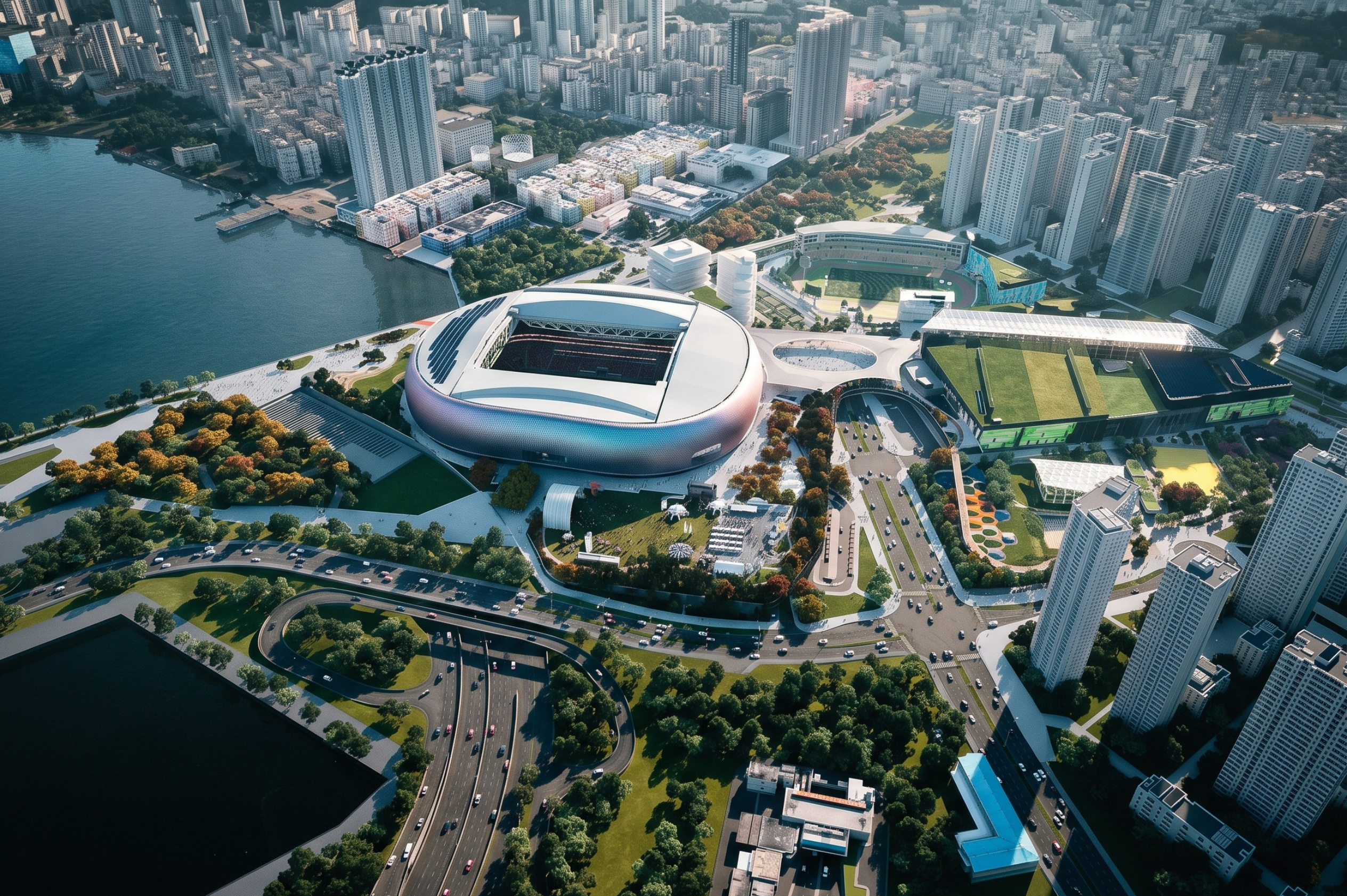
If you have watched a Super Bowl, an Olympic Games, a match at Tottenham Hotspur Stadium or a concert under the shimmering skin of Hong Kong’s Kai Tak Stadium, you have been inside its work. This edition is not a fan letter. It is an autopsy of a business model: how the firm became dominant, how it wins work, how it delivers it, where the model is genuinely brilliant, and where the industry should ask harder questions. Then we turn it into a playbook for smaller practices in Nairobi, Lagos, Casablanca, Monterrey, Manchester, and everywhere else that want to build the next one.
1. From a defecting studio to an independent giant
The 1983 bet on one building type
The firm began in 1983 when four partners, Chris Carver, Ron Labinski, Joe Spear and Dennis Wellner, left the Kansas City practice HNTB/Kivett Myers, where they had already specialised in sports work.42 They set up inside the St Louis giant HOK as a dedicated sports division, first called the Sports Facilities Group and later HOK Sport Venue Event, with Labinski often described as the world’s first sports venue architect. The structural decision matters more than the names: they bet an entire practice on one building type at a moment when most architects treated stadiums as a side job.
In 1998 the studio merged with LOBB Partnership, which had offices in London and Brisbane. That merger quietly created the three-hub geography (Kansas City, London, Brisbane) that still defines how the company staffs work across time zones today.
Camden Yards: the specialist moment, with a twist
The mythology says HOK Sport invented the retro, single-sport ballpark at Oriole Park at Camden Yards in 1992. The truth is more useful. The firm had tested the idea at minor-league level four years earlier at Pilot Field in Buffalo.6 And in Baltimore, its early work actually explored conventional multipurpose replacements on sites outside the city; it was the Orioles organisation that pushed for a traditional, baseball-only park downtown.3 The Maryland Stadium Authority paired the architects with the club’s own design director, Janet Marie Smith.4
What HOK Sport did brilliantly was listen, then industrialise the insight. The design kept and renovated the 1899 B&O warehouse as a backdrop rather than demolishing it.5 When the park opened, 17 major-league teams were still playing in shared multipurpose stadiums.5 The Orioles posted the second-highest attendance in the majors in their first two seasons there,4 and the retro wave that followed was dominated by the same specialist firm.3
Lesson one, before we go further: the firm’s defining idea was co-authored by a demanding client. Specialists win by absorbing those ideas faster than anyone else.
The management buy-out: buying the right to stay narrow
By 2008 the sports group had grown, in Rod Sheard’s words, into roughly 500 people with a £75m turnover.2 At the end of that year its managers bought the business out of HOK Group, and in early 2009 it relaunched as Populous, independently owned and operated.1 Publicly, Sheard framed it as two philosophies (generalist and specialist) that were better off apart; at the time, some industry observers speculated the separation had been pushed by the parent.2 Either way, the outcome was the same: the specialist got to set its own strategy, keep its own profits and choose its own partners.
Capital came later, and carefully. In 2023 Populous announced a strategic minority investment from Providence Equity Partners,1 which brought growth money without surrendering control. In June 2025 it acquired Denver’s Fentress Architects, whose portfolio spans more than $52 billion of work including Denver and Incheon international airports, and folded its own aviation team into a new unit, Fentress Studios, a Populous Company.7
Read the acquisition as risk management rather than vanity. Stadium demand is lumpy: it spikes around World Cups, Olympic cycles and franchise relocations, then drops. Airports, convention centres and civic buildings run on different public-spending cycles but share the same core problem Populous is best at: moving huge crowds through a building calmly. Diversification into adjacent crowd-heavy typologies smooths revenue without diluting the brand.

Four decades in eight beats. The two lime markers are the moments the business model changed shape, not just the portfolio. Sources: 1, 6, 7, 28, 30.

Headcount roughly tripled after independence, with the 2025 Fentress acquisition contributing to the latest jump. Sources: 2, 37, 17.
2. How Populous wins work: arriving early, not skipping the queue
Our brief for this edition asked how Populous captures multi-billion-dollar bids “before the public RFP stage”. It is a common belief in the industry, and it needs correcting before it hardens into folklore. The public record does not show Populous bypassing procurement. It shows something more interesting and more replicable: the firm is often in the room years before procurement opens, doing the thinking that shapes what the eventual tender asks for, and then it competes for that tender like everyone else.
Two 2026 examples make the pattern visible. In Frankfurt, Populous completed a feasibility study for the P9 multi-purpose arena in 2024, and was then appointed lead designer in July 2026 following a Europe-wide procurement process.17 In east London, it did feasibility work in 2024 on London Stadium and the land around it, then was appointed Lead Consultant for a spatial strategy that explores hotels, conferencing, leisure and a possible second venue.16 And in Riyadh, the 92,000-seat King Salman Stadium was won the hard way: Populous beat five other practices in an international competition.18
A fairness flag for public clients
Early advisory work gives any firm a deep knowledge advantage. Good procurement handles this by publishing the feasibility findings to all bidders and keeping the scoring transparent. If you sit on a council or a federation, ask that question before you sign the study.
Engine one: the commercial brain inside the design firm
Populous runs its own business consultancy, Populous Consulting, which describes itself as a specialist venue consultancy that brings customer insight and business analysis into the design process.14 Its graduate roles list financial modelling and projections for venue strategies as core work.12 At Athens’ Nikos Galis Olympic Indoor Hall, a 2004 Games arena, the team benchmarked the market, proposed a 365-day events programme, and wrote a business plan showing the commercial uplift a renovation could unlock.12
In 2026 the firm formalised this as Populous Strategy, a three-phase service built to sit alongside architectural workflows, covering venue strategy (product mix and operational vision) and experience strategy (fan journeys, hospitality and digital layers), with Benfica’s district project cited as an early success.13 A separate Real Estate Strategy service now handles site strategy, feasibility, governance, phasing and entitlement for the districts around venues.15 Strategically, that is the point: by the time a client writes an RFP, the scenario model that justified the project may already have Populous’ logic baked into it.
Engine two: the event overlay flywheel
This is the least glamorous and most underrated part of the business. Populous says it has helped stage every Super Bowl since 1987 and every Summer and Winter Olympic and Paralympic Games since 1996, and is often involved as early as pre-bid planning.8 “Overlay” is the temporary layer that makes a permanent building work for a mega-event: the master plan for operations, programming and temporary facilities.9 For a Super Bowl that work begins roughly two years out and includes temporarily redesigning entrances, exits and security checkpoints for the crowd.10 For PyeongChang 2018 the firm advised the organising committee’s venues department on overlay, temporary construction, procurement and Games-time site management.11
Why it matters commercially: each event is a live stress test of dozens of venues the firm did not design. Every queue that backs up, every broadcast compound that does not fit, every security line that collapses in the rain becomes institutional knowledge. That knowledge is then sold back as better permanent design, and the relationships built with leagues and organising committees turn into early conversations about the next venue. The firm’s late overlay pioneer Jerry Anderson was remembered by colleagues as much for managing conflicting people under pressure as for his architecture; one recalled him locating a suspicious package during a credible bomb threat at a Super Bowl.9 That is security and operations knowledge you cannot learn from a render.
Engine three: partnership as cross-border insurance
The evidence here is clear but easy to misread. Populous rarely works abroad alone, yet many of its most famous overseas venues were partnerships where a local firm led or co-led. In Johannesburg, Boogertman Urban Edge + Partners developed the calabash concept for Soccer City and, according to the city, brought Populous in even though it was not required to.23 In Casablanca, Paris-based Oualalou + Choi is the lead architect on the 115,000-seat Grand Stade Hassan II, with Populous as collaborator.21 In Christchurch, Populous and Warren and Mahoney co-led the design of Te Kaha.30 Monterrey’s Estadio BBVA was designed by a Mexican-American HOK Sport team that later divided into Populous and VFO Arquitectos.33
That structure spreads risk the way a formal joint venture would. The local partner carries codes, permitting, political relationships, cultural authorship and on-the-ground supervision. Populous carries the typology: sightlines, egress, hospitality yield, broadcast needs, FIFA and IOC compliance. Contractors often add their own cross-border layer: Soccer City’s main contractor was a South African firm in joint venture with the Dutch group BAM.25

The real moat is the loop, not any single stage. Stage 5 (events) is where competitors usually have no seat at the table. Sources: 8, 12, 13, 17, 18.
3. Inside the delivery machine
Who actually runs a Populous project
Populous does not publish an org chart, so treat the structure below as an informed reconstruction from its own job descriptions and staff biographies. A senior principal or project director owns the client relationship and commercial outcome. Design principals hold the architectural idea. Project architects and project managers run the programme day to day. Beneath and beside them sits a digital spine that most firms of its size still lack.
A recent Brisbane posting for a Senior BIM Coordinator shows how that spine is wired: the role reports to the APAC Head of Digital, partners with regional BIM managers on BIM execution planning, and helps prepare the BIM and digital parts of bids and tenders.34 Digital is not a back-office service; it is part of how the firm wins. A Global Digital team hires computational designers to build tools, automate analysis and spread new workflows across studios worldwide.36 And a Global BIM Strategy Committee, with representatives from the USA, Europe and Asia Pacific, meets yearly to review and audit the firm’s BIM systems and protocols.35

The dashed links are where projects succeed or fail: decisions on the left must land in the model on the right the same day. Sources: 34, 35, 36.
The “round-the-clock” question
It is tempting to picture a follow-the-sun studio where London hands a model to Brisbane at dusk and Kansas City picks it up at dawn. Populous does staff projects across time zones and moves specialists between continents as tournament calendars demand,39 and in 2022 it had 16 people working on site at Kai Tak, some relocated from other offices.37 But we found no public evidence of a formal 24-hour production cycle. The more honest, and more transferable, insight is this: what makes distributed work possible is not the clock. It is shared protocols, audited centrally, so a model built in one office is legible in another. Without that discipline, “round-the-clock” simply means round-the-clock rework, and tired people.
The model itself is Autodesk Revit, which a Populous digital lead calls the backbone of everything the firm does; Kai Tak Sports Park was developed entirely in it.26 On top of that, the firm uses machine learning when designing seating bowls, testing how ticketing sections should be segmented for different concert configurations and sports so the bowl earns its keep across formats.26
Industrialised construction: designing what factories can make
Here is the clearest, best-documented example of Populous changing the economics of a building. Kai Tak Stadium’s first façade design called for more than 47,000 aluminium panels in 8,000 shapes and sizes, almost all bespoke. Working directly with façade engineers and the manufacturer during construction, the team reduced that to 27,000 panels in just two varieties, saving more than 1,000 tonnes of concrete, using 40% less steel and cutting the façade price by roughly a quarter.26

Panel and type counts drawn to scale; the “2 types” bar is deliberately a sliver. The point is not the percentage, it is the moment: this happened during the pandemic, when bespoke supply chains were failing. Source: 26.
The second example is even more radical. For the 2024 ICC Men’s T20 World Cup in New York, Populous designed the 34,000-seat Nassau County International Cricket Stadium as a temporary venue, with the bulk of the bowl built from grandstands reused from the Las Vegas Formula 1 race.27 The amenities, from VIP clubs to broadcast spaces and locker rooms, were assembled from seven module groups based on standard event-rental components; the venue went from blank paper to opening day in nine months and was dismantled two weeks after the tournament, leaving only the pitch.26

Simplified illustration of the Nassau County kit-of-parts logic. Only the triangular wedges between modular stands were built conventionally. Sources: 26, 27.
Where the trade-offs bite
Standardisation is not free. A façade reduced to two panel types needs stronger architecture elsewhere to stay distinctive, and Kai Tak arguably proves it can be done. Temporary venues are only as green as their next use; reuse that is promised but never booked becomes landfill with a press release. And when architects pull manufacturers into design, they edge into territory contractors usually control, which can blur liability on design-and-build contracts. Populous’ digital leads openly argue that architects should have more influence over what gets manufactured.26 That is a healthy push, but clients should write it into contracts deliberately, not discover it in a dispute.
The firm’s own justification is blunt about utilisation: venues that cost billions may be used somewhere between 30 and 220 times a year.26 Hong Kong took that seriously in a way few cities do. Kai Tak’s operator faces penalties of HK$500,000 for every day the main stadium misses its usage requirements.29 Design flexibility stops being a nice-to-have when idleness has a daily fine attached.
4. The portfolio, read as a world map of problems
A list of famous stadiums tells you little. What is revealing is that each landmark below solved a different constraint: heritage, climate, seismicity, neighbours, water, money. We have deliberately weighted this away from the UK and US, because some of the firm’s most instructive work sits in Africa, Asia, Oceania and Latin America.

Soccer City (FNB Stadium), Johannesburg
Africa · 2010 World Cup final · with Boogertman Urban Edge + Partners
Rebuilt between 2007 and 2010 around the profile of the 1980s stadium, it became Africa’s largest at 94,736 seats.24,25 The calabash skin carries ten vertical slots aligned to the other 2010 venues and Berlin.24 The deeper lesson is authorship: a South African firm led, and chose to bring in the global specialist.23

Grand Stade Hassan II, Casablanca
Africa · in development · Oualalou + Choi lead, with Populous
A planned 115,000-seat venue whose tent-like aluminium-mesh roof draws on the moussem, Morocco’s seasonal festival gatherings.20 It is designed to host the 2030 World Cup final and will be home to two local clubs.21 The open question is legacy: the site sits roughly 40 km from central Casablanca, which critics flag as a transport and usage risk.22

Kai Tak Sports Park, Hong Kong
Asia · opened 1 March 2025 · masterplan and stadium by Populous
A 50,000-seat stadium on the old airport, with a retractable roof covering 14,200 m² of moving panels.28 Engineers say it closes in about 30 minutes and is acoustically sealed because homes are close by.40 Next door, an arena with 80% retractable or removable seats and a 5,000-seat youth sports ground give the park a community-scale heartbeat.28

King Salman Stadium, Riyadh
Middle East · due 2029 · won in a six-firm competition
A 92,000-seat national stadium designed to host the 2034 World Cup final, its form drawn from mountain landscape with large green walls.19 Roof gardens and a walking path climb the building, and the brief calls for sustainable cooling of seats and pitch.18 In desert heat, that cooling load is the sustainability story to watch, more than the greenery.

One New Zealand Stadium at Te Kaha, Christchurch
Oceania · opened 27 March 2026 · with Warren and Mahoney
The NZ$683 million final piece of the city’s post-earthquake rebuild, delivered on time and within budget according to the mayor.30 It sits near two active faults, so it had to resist seismic events during construction too, and it is only the second permanently roofed stadium with natural grass, after Populous’ own Forsyth Barr in Dunedin.31 Its name was gifted by Ngāi Tūāhuriri.30

Estadio BBVA, Monterrey
Latin America · 2015 · with VFO Arquitectos · 2026 World Cup host
The bowl drops on its southern side to frame the mountains beyond.33 More than a third of the site is green, including about 30,000 m² of grass parking that filters rainwater back to local aquifers,32 and it earned LEED Silver.43 Grassroots-level water thinking, applied at 50,000-seat scale.
Community scale, and what is next
Populous is not only mega-venues. An earlier community-scale example is the 25,000-capacity Metricon Stadium on Australia’s Gold Coast, which its designers described as a new take on the community stadium; it was completed on time and under budget, and its roof supplies around 20% of its power.38 That is the scale at which most of our readers will actually work, and it is a reminder that the firm’s core skill, crowd comfort per dollar, travels down as well as up.
In the pipeline: the Frankfurt P9 arena,17 the London Stadium district transformation,16 the cliff-top Prince Mohammed bin Salman Stadium and other Saudi 2034 venues,27 Casablanca, and, according to Mexican press, a new stadium for Tigres in Nuevo León plus involvement in the Estadio Azteca renovation.41
5. The playbook for the next generation of venue firms
You do not need 1,500 people to use what Populous learned. You need the right moves in roughly the right order. Here they are, sequenced the way a young practice, a contractor’s design team or a sports consultancy can realistically afford them.
1. Choose a lane narrow enough to own. In 1983 the founders bet everything on one building type.42 Today’s equivalent might be community football grounds, women’s-sport venues, school sports hubs or temporary fan zones. Narrowness is what lets you build data no generalist has: costs per seat, changing-room counts that actually work, maintenance budgets after year three.
2. Sell the thinking before the building. Populous’ consultancy writes business plans and year-round event programmes before a line is drawn.12 A small firm can offer a fixed-fee utilisation audit for a county ground or municipal stadium: how many days it is used, by whom, and what would double that. It is cheap to deliver, valuable to clients, and it puts you in the room years before a tender.
3. Be the local partner a global firm cannot win without. Soccer City, Casablanca, Monterrey and Christchurch all paired a home practice with the specialist, and in Johannesburg and Casablanca the local firm led.23,21 With major tournaments heading across Africa, the Gulf and Latin America, firms that combine local codes, culture and contractor relationships with credible venue knowledge will be courted, not hired as drafters. Negotiate authorship and fee share accordingly.
4. Earn your stripes on event days. The overlay business taught Populous where buildings fail under pressure.9 Volunteer or bid for matchday operations, fan zones, cup finals and festivals. Walk the queues. Time the turnstiles. That operational evidence is the most persuasive thing you will ever put in a proposal.
5. Write your digital rulebook before you need it. A one-page BIM execution plan, a naming convention and a quarterly audit cost almost nothing now and save a fortune when you add a second office or a partner in another time zone. Populous audits its protocols globally every year.35 Copy the habit, not the software bill.
6. Design with the factory, and with what your country makes. Kai Tak went from 8,000 panel types to two.26 For many emerging markets the equivalent is designing around locally rolled steel sections, standard precast seating units or reusable grandstand hire, cutting imports, cost and carbon at once.
7. Take money without losing the steering wheel. Populous bought its independence first and accepted outside capital later, as a minority stake.1 If you raise investment, protect the right to stay specialist.
8. Prove what happens after opening night. Utilisation is the metric the whole industry under-reports. Track and publish it for your venues. Hong Kong attached daily penalties to idle days at Kai Tak;29 the firms that can show strong post-occupancy numbers will win the next decade.

6. What the industry should do better
Admiration should not become silence. Four questions deserve more scrutiny, for Populous and for every firm chasing its model. First, transparency: when the same firm writes the feasibility study and bids for the design, clients should publish that study to every bidder. Second, location and legacy: a 115,000-seat venue 40 km from the city it represents can be a triumph on final day and a burden on a wet Tuesday.22 Third, energy honesty: green walls and roof gardens in Riyadh are welcome, but the decisive number will be the cooling load, and it should be published.18 Fourth, staffing reality: global, cross-time-zone delivery is a competitive advantage only if it is designed around people’s working hours, not on top of them.
The takeaway
Populous did not become dominant by drawing prettier stadiums. It became dominant by owning the whole life of a venue: the business case before it, the event inside it and the lessons after it, then feeding every one of those back into the next drawing. That loop is open to anyone willing to specialise, partner generously and measure honestly.
Your turn. Which venue near you is the best, or worst, example of designing for the whole life of a building? Reply, tag us, or send us the utilisation numbers nobody publishes. Bowl & Beam exists to make sports infrastructure legible to the people who use it, pay for it and build it.
Sources
1. Wikipedia, “Populous Holdings” (buy-out Jan 2009; 1998 LOBB merger; 2023 Providence Equity minority investment). Link
2. Around the Rings / Infobae, “HOK Sport rebranded as Populous” (Rod Sheard on the buy-out; ~500 staff, £75m turnover; observer speculation). Link
3. SAH Archipedia, “Oriole Park at Camden Yards”. Link
4. 99% Invisible, “In the Same Ballpark”. Link
5. National Trust for Historic Preservation, “40 places under 40 years old”. Link
6. Wikipedia, “Oriole Park at Camden Yards” (Pilot Field precedent). Link
7. Building Design + Construction, “Populous acquires Fentress Architects” (June 2025). Link
8. Populous, Event discipline page. Link
9. Sports Business Journal, “Breaking Ground” (2014), and Around the Rings on Jerry Anderson. Link · Link 2
10. Colorado Country Life, on Populous’ Denver events team. Link
11. Populous, “25 years of designing Olympic events”. Link
12. Populous, Nikos Galis Olympic Indoor Hall feasibility (2024); Bright Network, Populous Consulting internship. Link · Link 2
13. The Stadium Business, “New Populous Strategy team…” (July 2026). Link
14. Populous, Disciplines and companies page. Link
15. Mondo Stadia, “Populous introduces Real Estate Strategy”. Link
16. Football Ground Guide, London Stadium appointment. Link
17. Sports Venue Business via Megaproject, Frankfurt P9 arena (July 2026). Link
18. Building, “Practice beats five rivals…” (King Salman Stadium); Sports Venue Business on cooling. Link · Link 2
19. Dezeen, “King Salman Stadium…” (2024). Link
20. Domus, Grand Stade Hassan II (2024). Link
21. BD Online and Yanko Design, Grand Stade Hassan II (lead architect, two clubs). Link · Link 2
22. StadiumDB, Grand Stade Hassan II construction page. Link
23. Brand South Africa, “Soccer City: an architect’s dream” (2010). Link
24. Domus (2010) and Dezeen (2010) on Soccer City. Link · Link 2
25. Wikipedia, “FNB Stadium”. Link
26. Autodesk Design & Make, “How Populous is innovating venue productization” (Dec 2024). Link
27. Dezeen, “Populous designs 34,000-seat temporary Cricket World Cup stadium” (2024). Link
28. Populous, Hong Kong Sevens at Kai Tak, facts and figures (March 2025). Link
29. Wikipedia, “Kai Tak Sports Park” (opening date, usage penalties). Link
30. Populous, Te Kaha opening release (March 2026). Link
31. Populous, Te Kaha project page. Link
32. Invisible Structures, Estadio BBVA project profile. Link
33. StadiumDB, Estadio BBVA design page; The Plan on the sloping bowl. Link · Link 2
34. Work180, Populous Senior BIM Coordinator listing. Link
35. Populous, Nathan Tobeck profile (Global BIM Strategy Committee). Link
36. Work180, Populous Computational Design Specialist listing. Link
37. Populous, “Tapping the power of a global knowledge network” (2022). Link
38. LSAA conference paper (2011), Eden Park and Metricon Stadium. Link
39. AEC+Tech, Populous company profile. Link
40. Arup, “Engineering marvel unveiled: Kai Tak Sports Park” (2025). Link
41. Excélsior, “¿Quién diseñó el Estadio BBVA de Monterrey?”. Link
42. Pacific Coast Architecture Database, HOK Sport firm record. Link
43. Wikipedia, “Estadio BBVA” (LEED Silver; 2026 World Cup matches). Link
Notes on uncertainty: the project hierarchy is a reconstruction from public job listings, not an official chart. Headcount figures come from different sources with different definitions. We found no public evidence of a formal 24-hour “follow-the-sun” production model or of Populous holding equity joint ventures abroad; partnerships described here are design collaborations and consortia. Venue illustrations are simplified original drawings, not reproductions of any firm’s renderings.